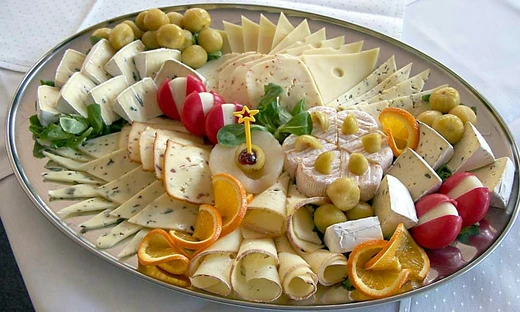
Provolone
Italian stretched-curd cheese with sharp or sweet varieties.
Provolone is an Italian semi-hard cheese made from cow's milk, originating in the Campania region near Vesuvius. It is an aged pasta filata (stretched-curd) cheese, produced in pear, sausage, or cone shapes 10 to 15 cm long. Provolone, along with its smaller variant provola and the grilled form provoleta, represents a traditional Italian cheese that has spread internationally.
- type
- Semi-hard cheese
- origin
- Italy (Campania region, near Vesuvius)
- milk
- Cow's milk
- varieties
- Provolone piccante (sharp) and provolone dolce (sweet)
- protected_designations
- Provolone Valpadana and provolone del Monaco (PDO)
- US_production_2023
- 170,000 tonnes (370 million pounds)
Lore & Background
The term provolone, meaning 'large provola,' appeared around the end of the 19th century, when it began to be manufactured in southern Italy and assumed its current large size. The smaller variant is called provola, sold in plain and smoked forms. Today, the most important production region is northwestern Italy, particularly the city of Cremona.
Reader's Guide
Provolone is significant as a traditional Italian pasta filata cheese that has become a global commodity. Its taste varies greatly: provolone piccante is aged at least four months and uses goat-derived lipase for a sharp, piquant flavor, while provolone dolce uses calf's lipase for a mild, sweet taste. Two varieties—Provolone Valpadana and provolone del Monaco—hold European Union protected designation of origin (PDO) status, meaning only Italy may legally produce cheese called 'provolone' within the EU. In South America (Brazil, Argentina, Bolivia, Uruguay), small discs of provolone are grilled until partially melted and served as a starter, often called provoleta. In the United States, provolone accounted for 2.5% of cheese production in 2023, with 170,000 tonnes made. Its adaptability—from aged sharp cheese to grilled appetizer—underscores its enduring appeal.
Did You Know?
- Provolone is an aged pasta filata (stretched-curd) cheese originating in the Campania region near Vesuvius.
- The term 'provolone' (meaning 'large provola') appeared around the end of the 19th century.
- Provolone piccante uses lipase derived from goat, while provolone dolce uses calf's lipase.
- In Brazil, Argentina, Bolivia, and Uruguay, grilled provolone discs are called provoleta.
More in Cheese 1-18
Spotted an error? Know more?
This is a living reference — every entry is fact-audited, and reader corrections feed straight into our audit queue. Suggest an edit · See this site's audit record