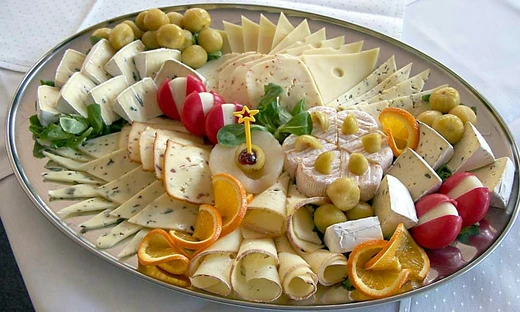
Gorgonzola
Italian blue cheese with protected origin and two main varieties.

Wikipedia / Wikimedia Commons
Gorgonzola is an Italian blue cheese made from unskimmed cow's milk, believed to have been created in the 9th century. Its name is controlled under a protected designation of origin (PDO), and it is produced mainly in the Italian regions of Piedmont and Lombardy. The cheese takes its name from the Lombardian town of Gorgonzola, Milan, where it originated, though other nearby localities dispute the claim of geographical origin.
- type
- Blue cheese
- milk
- Unskimmed cow's milk
- origin
- Gorgonzola, Milan, Italy (disputed)
- created
- Believed 9th century; first recorded mold in 11th century
- varieties
- Dolce and piccante
- aging
- Typically 3–4 months
- PDO status
- Recognized as DOC in 1955; registered as DOP in 1996
Lore & Background
Gorgonzola has been produced for centuries in Gorgonzola, Milan, acquiring its greenish-blue marbling in the 11th century. The town's claim of geographical origin is disputed by other nearby localities, such as Pasturo nella Valsassina, due to natural caves with ideal temperatures for cheese making. A Lombardy legend tells of a cheese maker who left fresh curds open all night while rushing to meet his lover; he later added more curds, and months later discovered a bluish mold that created the cheese's unique taste, marking the first discovery of the erborinatura process.
Reader's Guide
Gorgonzola is significant as a historic Italian blue cheese with a protected designation of origin (PDO) since 1996, ensuring that within the EU and recognizing countries, only cheese from specific provinces in Piedmont and Lombardy may bear the name. Its two dominant variations—dolce, with a delicate flavor and buttery consistency, and piccante, with a pungent flavor and firm, crumbly texture—offer distinct culinary uses. The cheese is an ingredient in pizza quattro formaggi, used as a topping for steak, melted into risotto, added to gnocchi or pasta, or served with polenta. Outside the EU, the name Gorgonzola may legally be used for imitations, such as those from Wisconsin and Vermont in the United States. Literary references include James Joyce's Ulysses, where the hero Bloom eats a Gorgonzola sandwich, and Richard Ellmann's interpretation linking it to Dante's Gorgon.
Did You Know?
- Gorgonzola was referred to as stracchino verde until the early 20th century.
- The cheese celebrates an annual festival each September called the Sagra Nazionale del Gorgonzola DOP.
- Metal rods are inserted and removed during aging to create air channels for mold growth.
- One ounce of Gorgonzola contains 100 calories, 9 g of fat, and 375 mg of sodium.
More in Cheese 1-18
Spotted an error? Know more?
This is a living reference — every entry is fact-audited, and reader corrections feed straight into our audit queue. Suggest an edit · See this site's audit record