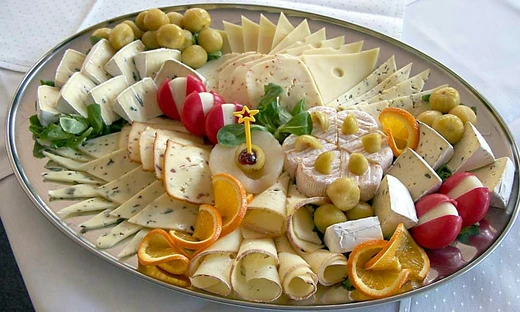
Mozzarella
A stretched-curd cheese from southern Italy, essential for pizza and Caprese.

Wikipedia / Wikimedia Commons
Mozzarella is a semi-soft, non-aged cheese made using the pasta filata (stretched-curd) method. It originated in southern Italy and is distinguished by the milk used: mozzarella fior di latte from cow's milk and buffalo mozzarella (mozzarella di bufala) from Italian buffalo milk. Fresh mozzarella is traditionally served the day it is made, has a high moisture content, and is used for pizza, pasta dishes, and Caprese salad.
- origin
- Southern Italy
- type
- Semi-soft, non-aged cheese
- milk_sources
- Cow's milk (fior di latte), Italian buffalo milk (mozzarella di bufala), sheep milk, goat milk
- production_method
- Pasta filata (stretched-curd)
- first_mentioned
- 1570 in a cookbook by Bartolomeo Scappi
- EU_protection
- Traditional Speciality Guaranteed (TSG) since 1996; PDO for mozzarella di bufala campana (1996)
Lore & Background
Mozzarella's etymology derives from southern Italian dialects, as the diminutive of 'mozza' (cut) or 'mozzare' (to cut off), referencing the method of working. The term first appears in 1570 in a cookbook by Bartolomeo Scappi. An earlier reference from Monsignor Alicandri describes the 12th-century Monastery of San Lorenzo in Capua offering pilgrims bread with 'mozza'.
Reader's Guide
Mozzarella's significance lies in its central role in Italian cuisine, particularly for pizza and Caprese salad. Its production method—pasta filata—involves stretching and kneading curd until smooth, then forming individual pieces. Fresh mozzarella is highly perishable, traditionally served the day it is made, but can be stored in brine for up to a week or vacuum-sealed longer. Low-moisture mozzarella, developed for pizza, has a longer shelf life. The cheese has EU recognition as a Traditional Speciality Guaranteed (TSG) since 1996, and the buffalo mozzarella from Campania, Lazio, Apulia, and Molise holds Protected Designation of Origin (PDO) status. Variants include smoked mozzarella, sheep milk mozzarella, and Turkish buffalo milk mozzarella from Çaycuma and Kandıra.
Did You Know?
- Fresh mozzarella makes a distinct squeaky sound when chewed or rubbed.
- Genetic research suggests buffalo came to Italy by migration of river buffalo from India in the 7th century CE.
- Mozzarella is the diminutive form of 'mozza' (cut), first mentioned in 1570 in a cookbook by Bartolomeo Scappi.
- Low-moisture mozzarella can be kept refrigerated for up to a month, with some shredded versions having a shelf life of up to six months.
Frequently Asked Questions
Who is Mozzarella?
Mozzarella is a semi-soft, non-aged cheese hailing from southern Italy, produced through the pasta filata (stretched-curd) technique. It first appears in the written record in Bartolomeo Scappi's 1570 cookbook.
What are Mozzarella's powers/role?
Its high moisture content and gentle, milky flavor make it the default cheese for pizza, pasta dishes, and the classic Caprese salad. It is traditionally meant to be eaten the same day it is made, while its texture is still at its peak.
How does Mozzarella's story end?
Fresh mozzarella has an extremely short prime window—often just one to two days after production—before its moisture and texture begin to shift. Once past that point, it is either consumed quickly or converted into a shelf-stable form.
Why is Mozzarella important?
It carries EU Traditional Speciality Guaranteed status (granted 1996), and the Campanian buffalo variant holds full PDO protection. These designations legally safeguard the stretched-curd method and the regional identity of the cheese.
What separates fior di latte from mozzarella di bufala?
Fior di latte is made from cow's milk, while mozzarella di bufala uses Italian water-buffalo milk, lending it a richer, faintly tangier character. Both follow the identical pasta filata process; the milk source is the sole defining distinction.
More in Cheese 1-18
Spotted an error? Know more?
This is a living reference — every entry is fact-audited, and reader corrections feed straight into our audit queue. Suggest an edit · See this site's audit record