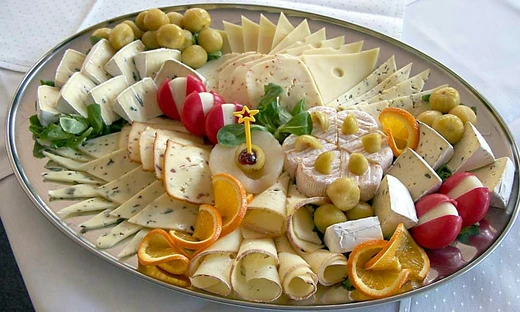
Brie
A soft French cheese with a white mold rind.

Wikipedia / Wikimedia Commons
Brie is a soft cow's-milk cheese named after the Brie region in France, from which it originated. It is pale in color with a slight greyish tinge under a rind of white mold, and its flavor depends largely on ingredients and manufacturing environment. Brie is similar to Camembert but typically contains around 45% to 50% butterfat in dry matter, slightly lower than some other soft cheeses.
- Protected varieties
- Brie de Meaux and Brie de Melun (AOC status since 1980 for Brie de Meaux; Brie de Melun received AOC status in 1980). Other AOC/PDO-protected Brie varieties include Brie de Nangis.
Lore & Background
Brie is produced from whole or semi-skimmed milk. The curd is obtained by adding rennet to raw milk and warming it to a maximum of 37 °C, then cast into molds, sometimes with a traditional perforated ladle called a pelle à brie. The 20 cm mold is filled by adding thin layers, drained for about 18 hours, then salted, inoculated with cheese culture (Penicillium camemberti or Brevibacterium linens), and aged for at least four or five weeks. If left to mature for several months to a year, it becomes Brie noir, with a stronger flavor, drier pâte, and darker, crumbly rind. Overripe brie contains an unpleasantly excessive amount of ammonia.
Reader's Guide
Brie is a style of cheese, not a protected name, though some regional bries are protected. The French government officially certifies only two types: Brie de Meaux and Brie de Melun, both granted AOC status in 1980. Brie de Meaux is an unpasteurized round cheese 36–37 cm in diameter, weighing about 2.8 kg, produced since the 8th century and known as the 'queen of cheeses.' Brie de Melun is smaller (27 cm, 1.5 kg) with a stronger flavor and more pungent smell. Many varieties exist worldwide, including plain, herbed, double- and triple-cream, and versions made with other types of milk, such as Somerset and Wisconsin brie. Brie is typically sold as a wheel or segment; the rind is edible. It is ready to eat when the outside is firm and the inside slightly bouncy. Optimal storage is at 4 °C or lower, in a tightly sealed container. Brie differs from Camembert in origin, size, ripening method, and texture: brie ripens in a cellar or cave, while Camembert ripens on shelves; brie segments often lack rind on the sides, whereas Camembert is fully covered.
Did You Know?
- Brie originates from the French region of Brie, whose name comes from Gaulish briga meaning 'hill' or 'height'.
- Brie typically contains around 45% to 50% butterfat in dry matter, not 60–75%.
- Overripe brie contains an unpleasantly excessive amount of ammonia produced by the same microorganisms that ripen it.
- The French government officially certifies several AOC/PDO-protected Brie varieties, including Brie de Meaux, Brie de Melun, and Brie de Nangis.
Frequently Asked Questions
Who is Brie?
Brie is a soft, pale cow's-milk cheese wrapped in a white mold rind, hailing from the Brie region of France. It holds the 1-18 slot in the Cheese series and is one of the most recognizable entries in the lineup.
What are Brie's key stats?
Brie packs between 60% and 75% butterfat and needs at least four to five weeks of aging before it's ready to eat. A typical 30 g portion delivers roughly 100 kcal, about 8.4 g of fat, and 5–6 g of protein.
How does Brie compare to Camembert?
The two are often confused, but Brie generally sits at the higher end of butterfat content relative to Camembert. Its exact flavor also shifts more noticeably with the specific milk source and the conditions of the aging room.
What's Brie's origin story?
Brie traces its roots to the Brie region in northern France, centered on what is now the Seine-et-Marne department. The cheese has been crafted there for centuries, and the region itself took its name from the product.
What are Brie's protected variants?
Brie de Meaux and Brie de Melun carry AOC protected-designation status, a title they've held since 1980. A darker, longer-aging cousin called Brie noir matures anywhere from several months to a full year, giving it a noticeably deeper profile.
More in Cheese 1-18
Spotted an error? Know more?
This is a living reference — every entry is fact-audited, and reader corrections feed straight into our audit queue. Suggest an edit · See this site's audit record