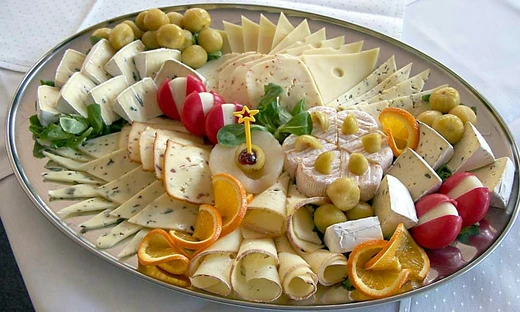
Emmental cheese
A Swiss cheese with holes, imitated worldwide.
Emmental is a yellow, medium-hard cheese with natural holes that originated in the Emme Valley in Switzerland. It is classified as a Swiss-type cheese and has a savoury but mild taste. The cheese is produced using three types of bacteria: Streptococcus thermophilus, Lactobacillus helveticus, and Propionibacterium freudenreichii. Historically, the holes were seen as a sign of imperfection, but modern production values them as a sign of maturation and quality.
- origin
- Emme Valley, Switzerland
- type
- Yellow, medium-hard cheese with natural holes
- classification
- Swiss-type cheese
- taste
- Savoury but mild
- key_bacteria
- Streptococcus thermophilus, Lactobacillus helveticus, Propionibacterium freudenreichii
- byproduct
- Ziger (whey cheese)
Lore & Background
Emmental cheese originates from the Emme Valley in Switzerland. While 'Emmentaler' is registered as a geographical indication in Switzerland, only a limited number of countries recognize the term as such. Similar cheeses from France, the Netherlands, Bavaria, and Finland are widely sold under the name 'Emmental'. In some parts of the world, 'Emmentaler' and 'Swiss cheese' are used interchangeably for Emmental-style cheese.
Reader's Guide
Emmental cheese is significant for its distinctive holes, which were long thought to be due to bacterial activity. In the 21st century, it was discovered that microscopic hay dust in the milk causes the holes: bacteria form around the dust particles and produce gas. Historically, holes were considered imperfections, but today they are valued as a sign of maturation and quality. Modern production techniques and milking machines reduce hay dust, leading to fewer and smaller holes in 21st-century Swiss cheeses. Holes can be restored by adding hay flower powder, but this is forbidden in Swiss cheeses. Emmental is usually consumed cold as chunks or slices and used in dishes like gratins. Several varieties are protected under EU law, including Allgäuer Emmentaler (PDO), Emmental de Savoie (PGI), and Emmental français est-central (PGI). The cheese is widely imitated around the world, often called 'Swiss cheese'.
Did You Know?
- The holes in Emmental are caused by microscopic hay dust in the milk, not just bacterial activity.
- Historically, cheese makers tried to avoid holes, but today they are valued as a sign of maturation and quality.
- Ziger, a whey cheese, is a by-product of Emmental manufacture.
- Emmentaler produced according to Swiss AOC rules must be made in small rural dairies with raw cow's milk and no preservatives or GMOs.
Frequently Asked Questions
Who is Emmental cheese?
Emmental is a yellow, medium-hard Swiss-type cheese that originated in the Emme Valley in Switzerland. It is immediately recognizable by its network of natural holes and its gentle, savoury flavour profile.
What are Emmental cheese's signature traits?
Its most iconic feature is the pattern of natural holes, which modern producers now celebrate as evidence of proper maturation rather than a defect. The cheese also carries a mild, savoury taste that makes it a versatile ingredient in everyday cooking.
How does Emmental cheese get its famous holes?
Three specific bacteria—Streptococcus thermophilus, Lactobacillus helveticus, and Propionibacterium freudenreichii—ferment during the ripening stage and release carbon dioxide, which forms the characteristic eyelets. Without this microbial trio, the cheese would lack its signature look.
What byproduct does Emmental cheese leave behind?
The whey that separates during Emmental production is traditionally captured and pressed into Ziger, a small whey cheese. This byproduct has long been a staple of Swiss mountain cuisine and represents a zero-waste approach to cheesemaking.
Why is Emmental cheese important to the wider cheese world?
As one of the most imitated Swiss cheeses on the planet, Emmental essentially set the template for the 'Swiss cheese with holes' archetype. Producers in countless countries still replicate its look and flavour, making it a foundational reference point in global cheese culture.
More in Cheese 1-18
Spotted an error? Know more?
This is a living reference — every entry is fact-audited, and reader corrections feed straight into our audit queue. Suggest an edit · See this site's audit record