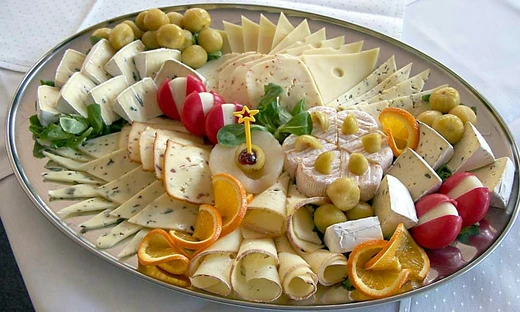
Roquefort
A protected blue cheese aged in the caves of Roquefort-sur-Soulzon.

Wikipedia / Wikimedia Commons
Roquefort is a sheep-milk blue cheese from southern France, recognized for its white, tangy, creamy texture and blue mold veins. It is produced exclusively in the natural Combalou caves of Roquefort-sur-Soulzon, and its name is protected by a geographical indication and a protected designation of origin under EU law. Often called the 'king of cheeses' in France, Roquefort has a long history dating back to medieval times and was the first cheese to receive France's Appellation d'Origine Contrôlée in 1925.
- type
- Sheep-milk blue cheese
- origin
- Roquefort-sur-Soulzon, Occitania, France
- milk_source
- Lacaune breed of sheep
- protected_designation
- Appellation d'Origine Contrôlée (1925), EU protected designation of origin
- annual_production
- Around 10,000 tonnes (3 million wheels)
- key_mold
- Penicillium roqueforti
Lore & Background
According to legend, Roquefort was discovered when a shepherd abandoned his lunch of bread and ewes' milk cheese in a cave after seeing a beautiful girl. Months later, the mold Penicillium roqueforti had transformed the plain cheese into Roquefort. In AD 79, Pliny the Elder praised cheeses from Lozère and Gévaudan, and in 1737 Jean Astruc suggested this referred to an ancestor of Roquefort, though others dispute this because Pliny does not clearly identify a blue cheese.
By the Middle Ages, Roquefort was a recognized cheese. On 4 June 1411, Charles VI granted a monopoly for ripening to the people of Roquefort-sur-Soulzon. Production grew from 300 tonnes in 1820 to 9,250 tonnes by 1914. In 1925, Roquefort received France's first Appellation d'Origine Contrôlée. A 1961 ruling by the Tribunal de Grande Instance at Millau decreed that only cheeses ripened in the natural caves of Mont Combalou could bear the name Roquefort.
Reader's Guide
Roquefort holds a significant place in French culinary history as the first cheese to receive an Appellation d'Origine Contrôlée in 1925, setting a precedent for protecting regional food products. Its production is strictly regulated: it must be made entirely from Lacaune sheep milk, aged in the natural Combalou caves of Roquefort-sur-Soulzon, and the entire maturation, cutting, packaging, and refrigeration process must occur in that commune. The cheese is white with blue mold veins, has no rind, and a characteristic tang from butyric acid. Around 4.5 liters of milk are needed per kilogram of cheese. As of 2009, seven producers make Roquefort, with Société des Caves de Roquefort (a Lactalis subsidiary since 1990) being the largest. Annual production is about 10,000 tonnes, making it France's second-most-popular cheese after Comté. The cheese has a high free glutamate content (1,280 mg per 100 g) and has been studied for anti-inflammatory properties, though Penicillium roqueforti does not produce penicillin. Regional cuisine in Aveyron includes many Roquefort-based recipes.
Did You Know?
- Roquefort is made entirely from the milk of the Lacaune breed of sheep.
- Each kilogram of Roquefort requires about 4.5 liters of milk.
- The cheese was the recipient of France's first Appellation d'Origine Contrôlée in 1925.
- A 2013 study found that proteins from Roquefort cheese inhibit chlamydia propagation and leukocyte migration.
More in Cheese 1-18
Spotted an error? Know more?
This is a living reference — every entry is fact-audited, and reader corrections feed straight into our audit queue. Suggest an edit · See this site's audit record