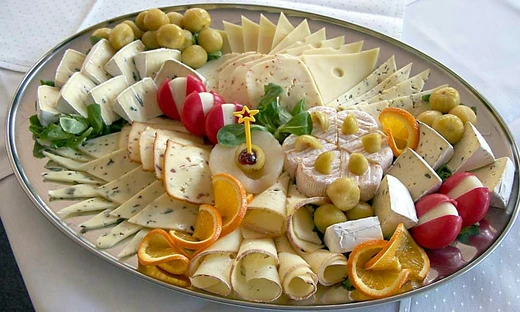
Gouda cheese
A Dutch cow's milk cheese traded in Gouda since the Middle Ages.
Gouda cheese is a family of yellow cow's milk cheeses originally from the Netherlands, named after the city of Gouda in South Holland, where it was traded in the Middle Ages. It ranges from young and elastic to old and hard, and from low-fat to high-fat, and today is a generic name for numerous similar cheeses produced worldwide.
- origin
- Netherlands
- type
- Cow's milk cheese
- named_after
- City of Gouda, South Holland
- key_feature
- Washed-curd cheese, aged from 4 weeks to 21 months
- protected_variants
- Boerenkaas, Noord-Hollandse Gouda, Gouda Holland
Lore & Background
The cheese is named after the city of Gouda, South Holland, because it was traded there. In the Middle Ages, Dutch cities could obtain feudal rights giving them primacy or a monopoly on certain goods. Within the County of Holland, Gouda acquired market rights on cheese, the sole right to have a market where county farmers could sell their cheese. All cheeses were taken to the market square in Gouda, where teams of cheese-porters, identified by distinct differently coloured straw hats, carried the farmers' cheeses—typically weighing about 16 kg—in barrows. Buyers sampled the cheeses and negotiated prices using a ritual bargaining system called handjeklap, in which buyers and sellers clap each other's hands and shout out various prices. Once a price was agreed, porters carried the cheese to the weighing house to complete the sale. Modern Gouda had evolved by the Dutch Golden Age of the 17th century.
Reader's Guide
Gouda cheese's significance lies in its historical role as a traded commodity in the medieval Netherlands, where the city of Gouda held exclusive market rights for cheese. This system shaped the cheese's identity and distribution. Today, Gouda is a generic name for similar cheeses produced globally, though protected designations like Boerenkaas, Noord-Hollandse Gouda, and Gouda Holland ensure that certain traditional varieties are made only in the Netherlands with Dutch cow's milk. The cheese's versatility—ranging from young and mild to old and crystalline—has made it widely popular. Its production process, including washing the curd to reduce lactose and aging for up to 21 months, creates a distinctive sweet and nutty flavor. Gouda remains a staple snack in the Netherlands, often eaten with mustard or beer, and its industrial production coexists with about 300 Dutch farmers who still make boerenkaas using traditional methods and unpasteurised milk.
Did You Know?
- Gouda cheese is named after the city of Gouda, South Holland, because it was traded there, not necessarily produced there.
- In the Middle Ages, Gouda acquired market rights giving it the sole right to hold a cheese market for the county's farmers.
- Cheesemaking was traditionally a woman's task in Dutch culture, with farmers' wives passing skills to their daughters.
- Gouda is a washed-curd cheese, which makes it sweeter by removing some lactose and reducing lactic acid.
Frequently Asked Questions
Who is Gouda cheese?
Gouda cheese is a family of yellow cow's milk cheeses that originated in the Netherlands. It takes its name from the city of Gouda in South Holland, where it was first traded during the Middle Ages.
What are Gouda cheese's powers/role?
As a washed-curd cheese, Gouda spans a wide spectrum of textures, from young and elastic to old and hard. It also covers a broad range of fat levels, from low-fat to high-fat, making it remarkably versatile.
How does Gouda cheese's story end?
Gouda's aging journey lasts anywhere from four weeks to twenty-one months. As it matures, the texture firms up and the flavor deepens, marking the natural endpoint of its development.
Why is Gouda cheese important?
Gouda has anchored Dutch dairy commerce since the Middle Ages, lending its name and economic identity to the city of Gouda. Today the term has become a generic label for countless similar cheeses produced around the globe.
What is Gouda cheese's family?
Several protected variants represent the official branches of the Gouda family, including Boerenkaas, Noord-Hollandse Gouda, and Gouda Holland. These region-specific versions carry formal designation while the broader name remains open to producers worldwide.
More in Cheese 1-18
Spotted an error? Know more?
This is a living reference — every entry is fact-audited, and reader corrections feed straight into our audit queue. Suggest an edit · See this site's audit record