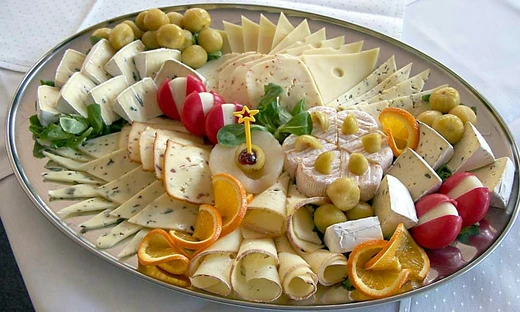
Cheddar cheese
Hard, sharp-tasting cheese from Somerset, England.
Cheddar cheese is a natural, relatively hard cheese originating from the village of Cheddar in Somerset, South West England. It is the most popular cheese in the United Kingdom and the second-most popular in the United States, and is produced worldwide without a protected designation of origin, though regional variants such as West Country Farmhouse Cheddar and Orkney Scottish Island Cheddar have protected geographical indications.
- origin
- Cheddar, Somerset, England
- type
- Natural hard cheese
- colour
- Off-white or orange (if annatto added)
- flavour
- Sharp, pungent, sometimes earthy
- UK market share
- 51% of £1.9 billion annual cheese market
- US annual consumption per capita
- 10 lb (4.5 kg)
- US production (2014)
- 3,000,000,000 lb (1,300,000 long tons; 1,400,000 tonnes)
Lore & Background
Cheddar cheese originates from the village of Cheddar in Somerset, southwest England. Cheddar Gorge contains caves that provided ideal humidity and steady temperature for maturing the cheese. The 19th-century Somerset dairyman Joseph Harding, called 'the father of cheddar', modernised and standardised production, introducing equipment such as his 'revolving breaker' for curd cutting and promoting dairy hygiene. His method was the first modern system based on scientific principles. Harding and his wife helped modernise cheddar production in Scotland and North America, while his sons Henry and William Harding helped modernise production in Australia and New Zealand, respectively.
During the Second World War and for nearly a decade after, most milk in Britain was used to make 'government cheddar' as part of war rationing, wiping out almost all other cheese production. Before the First World War, around 3,500–4,000 farmhouse cheesemakers were in Britain; fewer than 100 remained after the Second World War. According to a USDA researcher, cheddar is the most studied cheese in scientific publications.
Cheddar is produced by separating curds and whey using rennet, with an additional 'cheddaring' step where curd is kneaded with salt, cut into cubes, stacked, and turned. Strong, extra-mature cheddar requires maturing for 15 months or more. Some cheddar is still matured in caves at Wookey Hole and Cheddar Gorge. The ideal quality was described by Joseph Harding in 1864 as 'close and firm in texture, yet mellow in character or quality; it is rich with a tendency to melt in the mouth, the flavour full and fine, approaching to that of a hazelnut.'
Reader's Guide
Cheddar cheese holds significant historical and cultural importance as the most popular cheese in the UK and a globally recognised variety. Its development was revolutionised by Joseph Harding in the 19th century, whose scientific approach and innovations standardised production and spread cheddar-making to Scotland, North America, Australia, and New Zealand. The cheese's association with Somerset caves and traditional methods has led to protected geographical indications for West Country Farmhouse Cheddar and Orkney Scottish Island Cheddar, though the name 'cheddar' itself remains unprotected. The Second World War's 'government cheddar' policy drastically reduced British cheese diversity, but cheddar's popularity endured. Today, cheddar is produced worldwide with wide variation in style and quality, including processed cheeses labelled as cheddar. Its sharp flavour, firm texture, and occasional calcium lactate crystals in aged varieties define its character. Cheddar's nutritional profile—rich in protein, fat, calcium, and vitamins—and its versatility have cemented its place in global cuisine, from cheese boards to cooked dishes. The Slow Food Movement has created a cheddar presidium arguing only three cheeses should be called 'original cheddar', requiring Somerset origin and traditional methods.
Did You Know?
- Cheddar cheese accounts for 51% of the UK's £1.9 billion annual cheese market.
- The United States produced approximately 3,000,000,000 lb of cheddar in 2014.
- Joseph Harding, known as 'the father of cheddar', introduced the 'revolving breaker' for curd cutting.
- During the Second World War, most British milk was used to make 'government cheddar', wiping out nearly all other cheese production.
More in Cheese 1-18
Spotted an error? Know more?
This is a living reference — every entry is fact-audited, and reader corrections feed straight into our audit queue. Suggest an edit · See this site's audit record